
Four Patterns in Nature and What They Reveal About Canine Evolution
Updated: Jul 22
In This Guide:
Introduction
Nature rarely works at random. When you look closely at living organisms, certain patterns appear again and again. These patterns help explain how life changes over time, why species look the way they do, and how they continue to survive in changing environments. Four of the most important patterns are divergence, genetic variation, adaptation and fossil species. Each of these tells part of the story of evolution.
Dogs offer a clear and familiar example of how these patterns play out in real life. From wolves roaming ancient landscapes to the wide variety of modern breeds, canine evolution shows how natural forces shape behaviour, appearance and survival traits. By understanding these four patterns, you can better grasp not only where dogs come from, but also why they behave the way they do today.
This guide explains each pattern in simple terms and then connects it directly to the evolution of dogs. The aim is to make complex ideas feel practical and relevant, especially if you are interested in how nature influences the animals we live with.
Divergence: How One Line Becomes Many
Divergence is the process by which a single species splits into multiple distinct groups over time. This usually happens when populations become separated, either by geography, climate or behaviour. Once separated, each group begins to develop its own traits based on its environment.
Over many generations, these differences become more pronounced. Eventually, the groups may become so different that they are considered separate species.
In the case of canines, divergence is central to their story. The ancestors of modern dogs were wolves, but not all wolves followed the same path. Some populations remained wild, while others began to interact with early human communities. This separation created different evolutionary pressures.
Wolves that stayed in the wild needed to be strong hunters, wary of humans and able to survive harsh conditions. Meanwhile, wolves that lingered near human settlements found new opportunities. Food scraps, shelter and reduced competition created a different environment. Over time, these wolves began to change.
This is where divergence becomes visible. The wolves that adapted to living near humans gradually developed traits that made them more suited to this lifestyle. They became less aggressive, more tolerant and better at interpreting human behaviour. These early changes laid the foundation for domesticated dogs.
As humans began to select and breed dogs for specific purposes, divergence accelerated. Herding dogs, hunting dogs and companion animals all developed distinct traits. What started as one ancestral species branched into hundreds of different breeds, each shaped by its role and environment.
Genetic Variation: The Raw Material of Change
Genetic variation refers to the differences in DNA between individuals within a species. Without variation, evolution cannot happen. It provides the raw material that natural selection acts upon.
Variation occurs through mutations, reproduction and the mixing of genes. Some variations are small and barely noticeable, while others can significantly affect an animal’s appearance or behaviour.
In canine evolution, genetic variation played a crucial role right from the beginning. Even within early wolf populations, there were differences in temperament, size and coat type. Some wolves were naturally more curious or less fearful of humans. These individuals were more likely to approach human settlements and benefit from available resources.
Humans, whether intentionally or not, began selecting for these traits. Dogs that were easier to manage or more cooperative were more likely to survive and reproduce. Over time, this selection amplified certain genetic traits.
Modern dog breeds show just how powerful genetic variation can be. The difference between a Great Dane and a Chihuahua is striking, yet both belong to the same species. This diversity comes from carefully selecting and breeding individuals with specific traits over many generations.
Genetic variation also explains behavioural differences. Some dogs have strong herding instincts, while others are more suited to companionship. These tendencies are rooted in their genetic makeup, shaped by both natural and human-driven selection.
Adaptation: Traits That Improve Survival
Adaptation is the process by which traits that improve survival and reproduction become more common in a population. These traits can be physical, behavioural or even physiological.
Adaptation is closely linked to both divergence and genetic variation. Variation provides the options, while environmental pressures determine which traits are beneficial.
In the wild, wolves adapt to their surroundings in ways that improve their chances of survival. Thick coats help in cold climates, while keen senses aid in hunting. Behavioural adaptations, such as pack cooperation, increase success when capturing prey.
When it comes to dogs, adaptation took a slightly different path due to human influence. Early dogs adapted not only to their environment but also to living alongside people. This included changes in diet, behaviour and communication.
One of the most important adaptations in dogs is their ability to read human cues. Dogs can follow pointing gestures, recognise facial expressions and respond to tone of voice. These skills are not as developed in wolves and are considered key adaptations that support life with humans.
Diet is another example. Dogs have adapted to digest a wider range of foods compared to their wolf ancestors. This includes starches found in human food. Such dietary flexibility made it easier for dogs to thrive in human settlements.
Different breeds also show specific adaptations based on their roles. Sighthounds have lean bodies built for speed, while working dogs often have strength and endurance. These traits did not appear overnight. They developed gradually through selection and environmental demands.
Fossil Species: Clues from the Past
Fossil species provide physical evidence of how organisms have changed over time. Fossils are preserved remains or traces of ancient life, and they allow scientists to track evolutionary changes across millions of years.
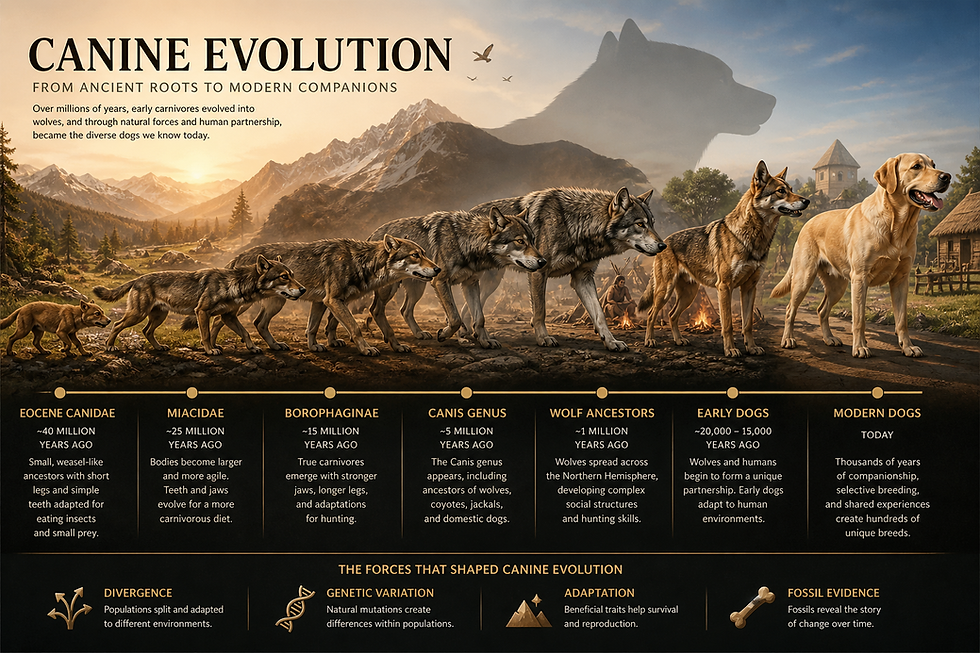
In the case of canines, fossil records show a gradual transformation from early carnivorous mammals to modern wolves and dogs. These fossils reveal changes in size, skull shape, teeth and limb structure.
Early ancestors of dogs were small, weasel-like creatures that lived around 40 million years ago. Over time, these animals evolved into larger, more specialised hunters. Fossil evidence shows how their bodies adapted for running, chasing and consuming meat.
By studying fossil species, scientists can identify when key changes occurred. For example, the development of stronger jaws or longer legs can be linked to shifts in diet or hunting strategies.
Fossils also help confirm the relationship between wolves and dogs. Although dogs themselves do not appear as early in the fossil record, their close connection to wolves is well supported by both physical evidence and genetic studies.
Understanding fossil species gives context to modern dogs. It shows that the traits we see today are the result of a long and gradual process, shaped by both natural forces and human influence.
Bringing It All Together: The Evolution of Dogs
When you combine divergence, genetic variation, adaptation and fossil evidence, a clear picture of canine evolution begins to form. It starts with early carnivorous mammals, whose fossil remains show gradual changes over millions of years. These changes reflect adaptation to different environments and ways of life. As these animals evolved, they gave rise to the ancestors of modern wolves.
Within wolf populations, genetic variation created differences in behaviour and physical traits. Some wolves were better suited to life near humans, while others remained fully wild. This is where divergence begins to take shape.
The wolves that moved closer to human settlements faced new conditions. Food sources changed, threats were different, and social interactions became more complex. These pressures led to adaptations that made them more compatible with humans.
Over time, these adapted wolves became early dogs. Humans then played a direct role in shaping their evolution by selecting for specific traits. This process greatly increased divergence, leading to the wide range of dog breeds we see today.
Each breed reflects a combination of these four patterns. Genetic variation provided the traits, adaptation refined them, divergence separated groups into distinct types, and fossil evidence helps trace the origins of the entire process.
Why This Matters for Understanding Dogs Today
Understanding these patterns is not just about history. It has practical value when it comes to living with dogs.
Recognising divergence helps explain why breeds behave differently. A herding dog’s instincts are not random, they are the result of generations of selection. Expecting all dogs to behave the same ignores their evolutionary background. Genetic variation reminds us that even within a breed, individual differences matter. Not every dog will fit a perfect mould. Personality, energy levels and learning ability can vary widely.
Adaptation highlights how dogs respond to their environment. Training, diet and daily routine all influence how a dog develops. While genetics set the foundation, experience shapes the outcome.
Fossil evidence offers perspective. It shows that dogs are part of a much larger evolutionary story. They are not separate from nature, but deeply connected to it.
Conclusion
Divergence, genetic variation, adaptation and fossil species are not abstract scientific ideas. They are practical patterns that help explain how life evolves and changes over time. When applied to dogs, these patterns reveal a story that is both complex and easy to relate to.
Dogs did not simply appear as they are today. They are the result of countless small changes, shaped by nature and guided by human influence. From ancient ancestors preserved in fossils to the diverse breeds we see now, every stage of their evolution reflects these four patterns.
Understanding this makes it easier to appreciate dogs for what they are. It also helps set realistic expectations when it comes to behaviour, training and care. When you see a dog, you are looking at the outcome of a long evolutionary journey, one that continues to this day.


